Rømer – Measurement of the Speed of Light
Historical reconstruction of the first measurement of the finite speed of light via Io eclipses (1676)
A simulation of Ole Rømer's 1676 observation. Rømer determined that the observed period of Jupiter's moon Io varies with the distance between Earth and Jupiter: as Earth moves away, the intervals between eclipses lengthen, and as Earth approaches, they shorten. From this signal delay, he concluded that light propagates at a finite speed.
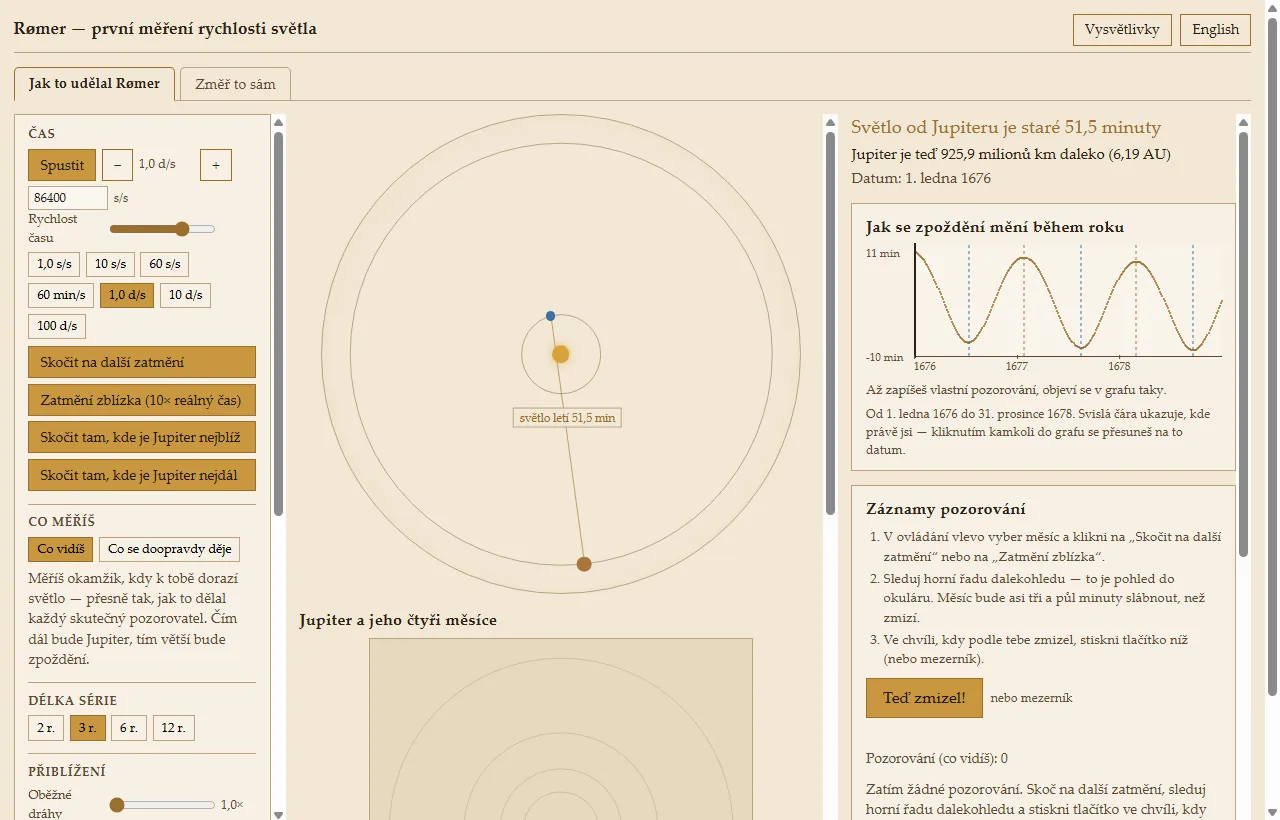
Observation of Io entering Jupiter's shadow and light signal delay tracking
Project Overview & Context
The simulation replicates the observation process step by step. It models the orbital motions of Earth and Jupiter, Io's orbit, and the signal travel time across the interplanetary distance. Users record eclipse ingress and egress timestamps through a simulated telescope and calculate the speed of light using Rømer's historical method and linear regression.
Key Features & Capabilities
Synthetic Telescope View
Telescope rendering of Jupiter and its moons as observed from Earth, including optical resolution and eclipse events.
Calculation Methods
Evaluation of the speed of light from cumulative delay between conjunction and opposition, or via regression of all observed eclipses.
Eclipse Event Logging
Table of eclipse times comparing theoretical undisplaced events with light-delayed observations.
Signal Delay Curve
Plot of time deviation as a function of orbital position, marking conjunction, opposition, and quadrature.
Educational Value & Pedagogical Context
Used in astronomy and physics courses to demonstrate how minute timing variations across interplanetary distances refuted the prevailing assumption of instantaneous light propagation.